Avast Continues to Say Netgear Router is Subject to Hacking
This article explains how to resolve the issue if Network Inspector in Avast Antivirus shows one of the following alerts:
Most wireless routers use encryption to protect your Wi-Fi network. Encryption works by securing your network with a password, which keeps out intruders and prevents attackers from eavesdroppng on your online activity.
Refer to the relevant information below according to the message you see after running a Network Inspector scan:
Either one of these issues means that an attacker could eavesdrop on the data that you send and receive over your Wi-Fi network, including your passwords, credit card info, and private messages and photos. Also, an attacker could use your Wi-Fi network to launch additional attacks or commit crimes. If an attack is traced back to your network, you may be liable.
To resolve these issues, enable WPA2 or WPA3 encryption on your router, and all of the devices connected to your Wi-Fi network. WPA3 encryption is the latest and most secure encryption method, but it may not be available on older router models. If your router does not support WPA3 encryption, you can enable WPA2 encryption, which still offers a high level of protection.
Almost all modern routers support at least WPA2 encryption, but if your router does not, we recommend replacing it.
When you enable WPA2 or WPA3 encryption on your router, you also need to set a password to secure your Wi-Fi network. We recommend that you set a strong password by following the guidelines below:
Select your router brand for detailed instructions on how to enable WPA2 or WPA3 encryption:
ASUS
Due to the wide range of different router types offered by Asus, we can only provide general instructions for frequently used models. For detailed instructions, consult the documentation for your specific router model. For further assistance, contact ASUS directly.
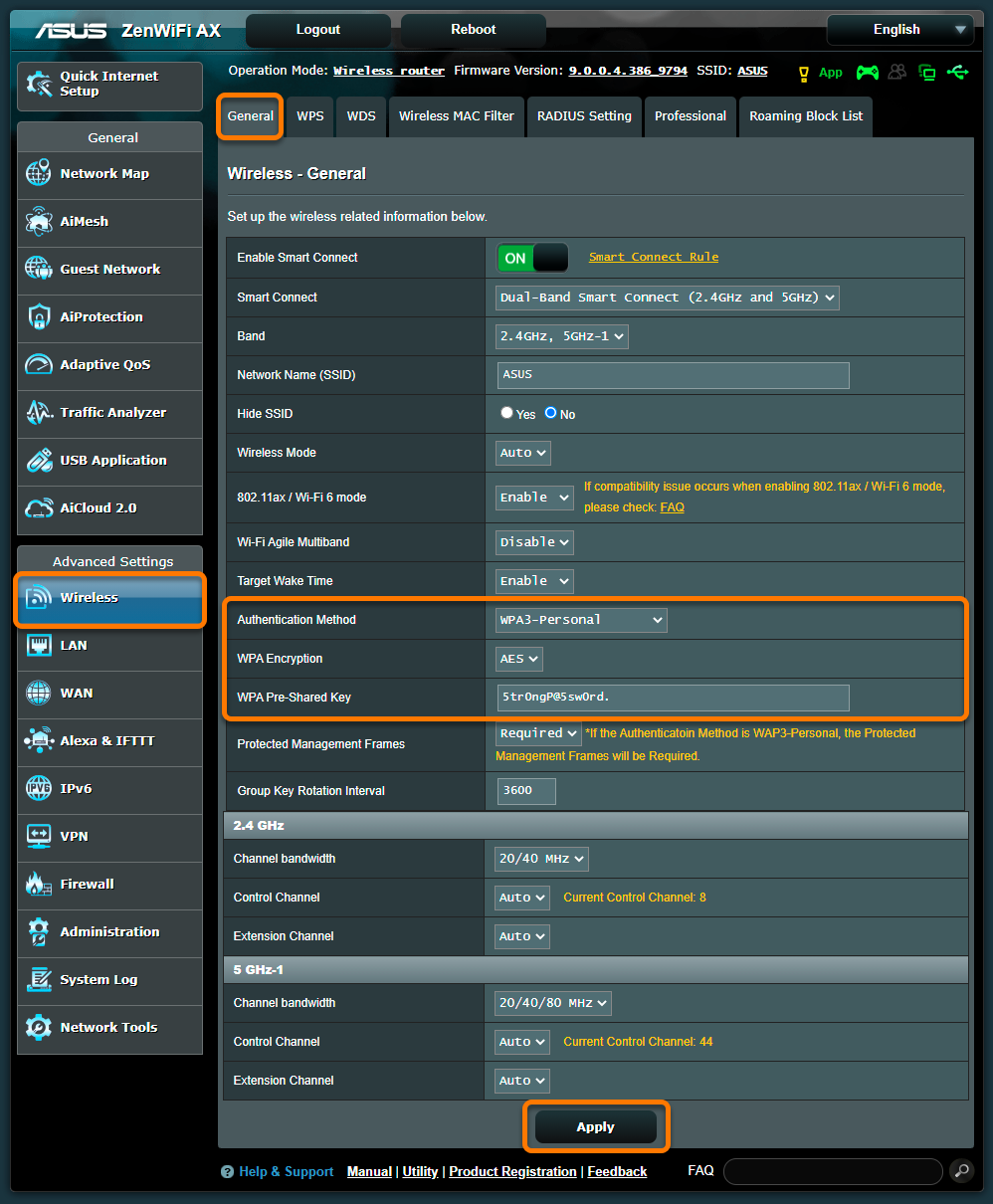
To configure an ASUS wireless router:
| 1. | From the Network Inspector results screen, select Go to your router settings to open the administration page of your ASUS router. |
| 2. | Enter your router username and password. If you do not know your login credentials, contact the party who provided the router. This is normally your Internet Service Provider (ISP). |
| 3. | Follow the step below that matches your router settings: Go to Advanced Settings ▸ Wireless ▸ General . OR Go to Wireless ▸ Interface . OR Go to Wireless ▸ Security . |
| 4. | Follow the step below that matches your router settings: For Authentication Method , select WPA3-Personal (or WPA2-Personal on older router models). OR For WPA3 Preauthentication (or WPA2 Preauthentication ), select Enabled . |
| 5. | For WPA Encryption , select AES , if available. |
| 6. | In the WPA Pre-Shared Key (or Passphrase ) field, create a strong password to encrypt your Wi-Fi network. |
| 7. | Confirm your changes by selecting Apply or Save , and reboot your router if necessary. |
| 8. | Repeat steps 3 - 7 for both 2.4 GHz and 5 GHz settings on dual-band routers. |
To configure wireless network devices:
| 1. | Go to the Wi-Fi settings for each device that is connected to your router, and view the Wi-Fi networks within range. |
| 2. | Select the name (SSID) of your Wi-Fi network from the list of available networks. |
| 3. | When prompted, enter the password (or Passphrase , Network/Pre-shared key etc.) that you specified when enabling secure encryption for your router. |
| 4. | If prompted, confirm that you want to establish a wireless connection between the device and your router. |
Belkin
Due to the wide range of different router types offered by Belkin, we can only provide general instructions for frequently used models. For detailed instructions, consult the documentation for your specific router model. For further assistance, contact Belkin directly.
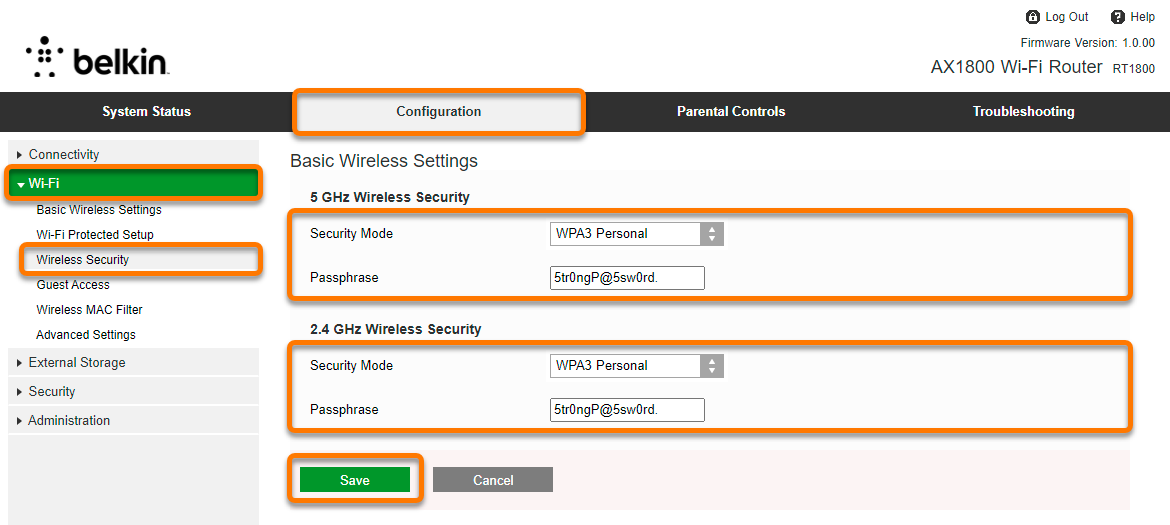
To configure a Belkin wireless router:
| 1. | From the Network Inspector results screen, select Go to your router settings to open the administration page of your Belkin router. |
| 2. | Enter your router username and password. If you do not know your login credentials, contact the party who provided the router. This is normally your Internet Service Provider (ISP). |
| 3. | Go to Configuration ▸ Wi-Fi ▸ Wireless Security . |
| 4. | For Security Mode , select WPA3-Personal (or WPA2-Personal on older router models). |
| 5. | In the Passphrase field, create a strong password to encrypt your Wi-Fi network. |
| 6. | Confirm your changes by selecting Save , and reboot your router if necessary. |
| 7. | Repeat steps 3 - 6 for both 2.4 GHz and 5 GHz settings on dual-band routers. |
To configure wireless network devices:
| 1. | Go to the Wi-Fi settings for each device that is connected to your router, and view the Wi-Fi networks within range. |
| 2. | Select the name (SSID) of your Wi-Fi network from the list of available networks. |
| 3. | When prompted, enter the password (or Passphrase , Network/Pre-shared key etc.) that you specified when enabling secure encryption for your router. |
| 4. | If prompted, confirm that you want to establish a wireless connection between the device and your router. |
Cisco
Due to the wide range of different router types offered by Cisco, we can only provide general instructions for frequently used models. For detailed instructions, consult the documentation for your specific router model. For further assistance, contact Cisco directly.
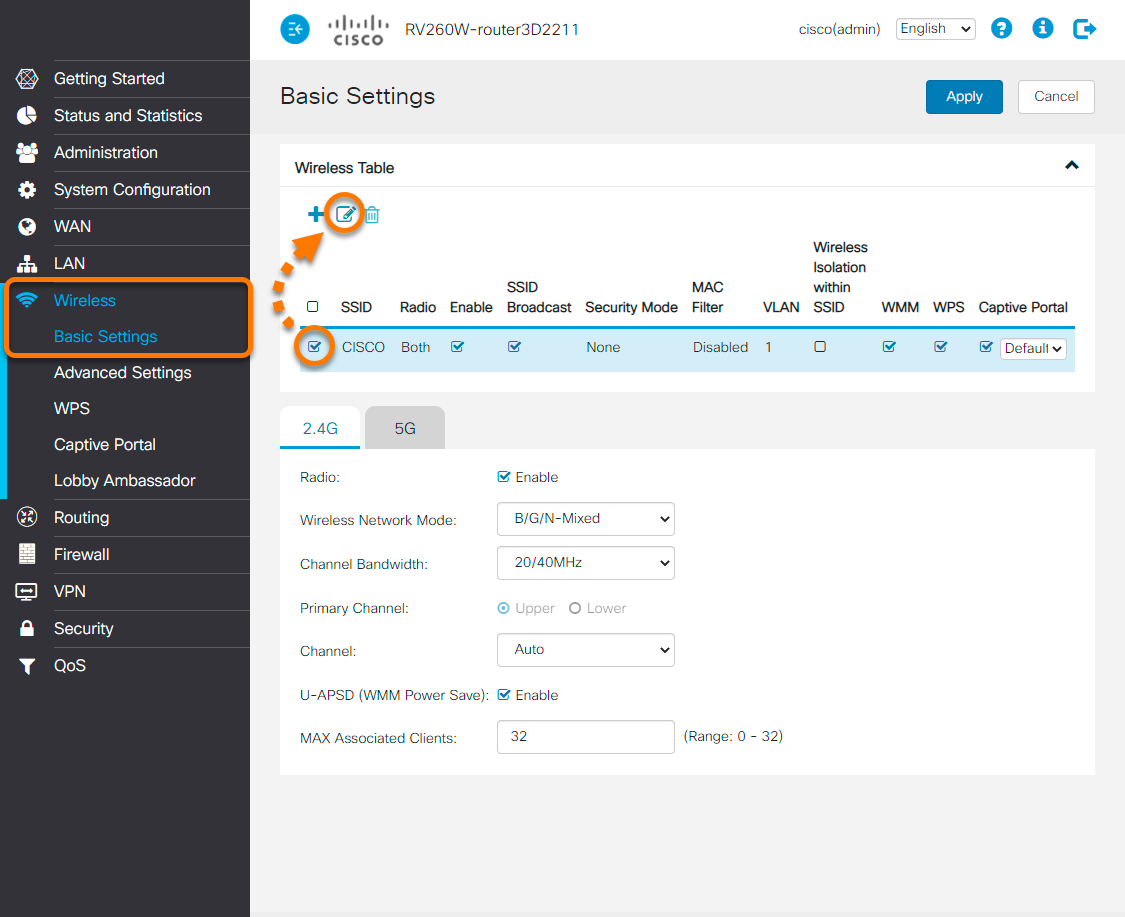
To configure a Cisco wireless router:
| 1. | From the Network Inspector results screen, select Go to your router settings to open the administration page of your Cisco router. |
| 2. | Enter your router username and password. If you do not know your login credentials, contact the party who provided the router. This is normally your Internet Service Provider (ISP). |
| 3. | Go to Wireless ▸ Basic Settings . |
| 4. | Tick the box next to the vulnerable wireless network, then select edit (the pencil icon). |
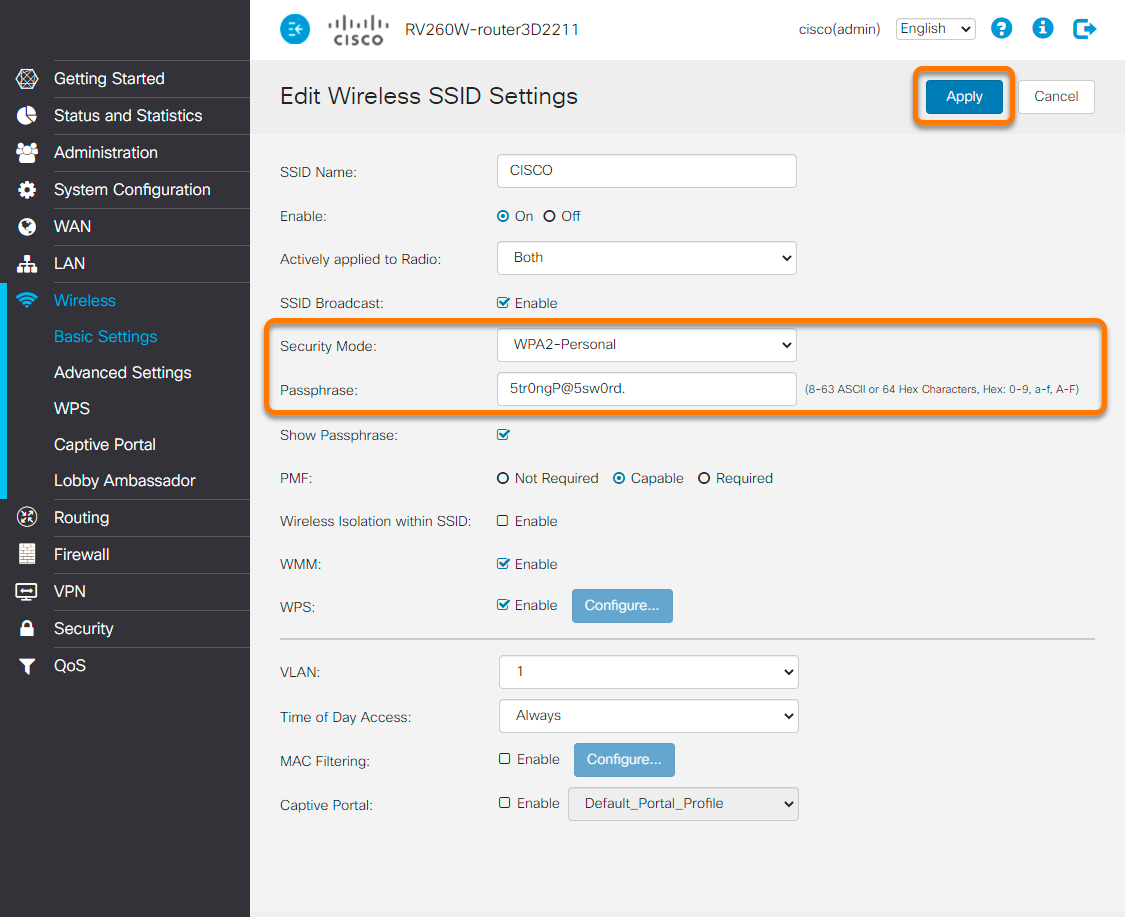
| 5. | For Security Mode , select WPA2-Personal (or WPA3-Personal on newer router models). |
| 6. | In the Passphrase field, create a strong password to encrypt your Wi-Fi network. |
| 7. | Confirm your changes by selecting Apply , and reboot your router if necessary. |
| 8. | Repeat steps 3 - 7 for both 2.4 GHz and 5 GHz settings on dual-band routers. |
To configure wireless network devices:
| 1. | Go to the Wi-Fi settings for each device that is connected to your router, and view the Wi-Fi networks within range. |
| 2. | Select the name (SSID) of your Wi-Fi network from the list of available networks. |
| 3. | When prompted, enter the password (or Passphrase , Network/Pre-shared key etc.) that you specified when enabling secure encryption for your router. |
| 4. | If prompted, confirm that you want to establish a wireless connection between the device and your router. |
D-Link
Due to the wide range of different router types offered by D-Link, we can only provide general instructions for frequently used models. For detailed instructions, consult the documentation for your specific router model. For further assistance, contact D-Link directly.
To configure a D-Link wireless router:
| 1. | From the Network Inspector results screen, select Go to your router settings to open the administration page of your D-Link router. |
| 2. | Enter your router username and password. If you do not know your login credentials, contact the party who provided the router. This is normally your Internet Service Provider (ISP). |
| 3. | Follow the step below that matches your router settings: Go to Settings ▸ Wireless . OR Go to Setup ▸ Wireless Settings ▸ Manual Wireless Network Setup . OR Go to Setup ▸ Wireless Connection ▸ Manual Wireless Connection Setup . |
| 4. | For Security Mode , select WPA/WPA2-Personal (or WPA2/WPA3-Personal on newer router models). |
| 5. | Follow any of the additional steps below that are available in your router settings:
If you do not see any of these options, proceed to step 6. |
| 6. | In the Password , Pre-Shared/Network Key , or Passphrase field, create a strong password to encrypt your Wi-Fi network. |
| 7. | Confirm your changes by selecting Save or Save settings . |
| 8. | Repeat steps 3 - 7 for both 2.4 GHz and 5 GHz settings on dual-band routers, and reboot your router if necessary. |
To configure wireless network devices:
| 1. | Go to the Wi-Fi settings for each device that is connected to your router, and view the Wi-Fi networks within range. |
| 2. | Select the name (SSID) of your Wi-Fi network from the list of available networks. |
| 3. | When prompted, enter the password (or Passphrase , Network/Pre-shared key etc.) that you specified when enabling secure encryption for your router. |
| 4. | If prompted, confirm that you want to establish a wireless connection between the device and your router. |

Huawei
Due to the wide range of different router types offered by Huawei, we can only provide general instructions for frequently used models. For detailed instructions, consult the documentation for your specific router model. For further assistance, contact Huawei directly.
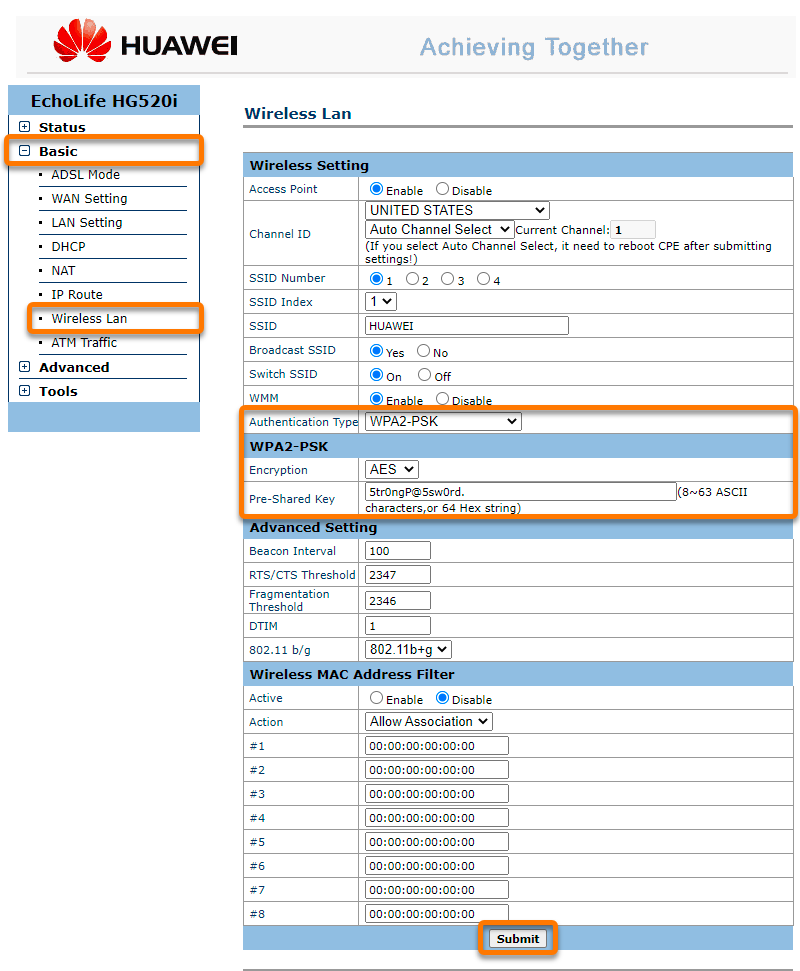
To configure a Huawei wireless router:
| 1. | From the Network Inspector results screen, select Go to your router settings to open the administration page of your Huawei router. |
| 2. | Enter your router username and password. If you do not know your login credentials, contact the party who provided the router. This is normally your Internet Service Provider (ISP). |
| 3. | Follow the step below that matches your router settings: Go to Basic ▸ Wireless LAN . OR Go to Basic ▸ WLAN ▸ WLAN . |
| 4. | For Authentication Type (or Security ), select WPA2-PSK (or WPA3-SAE on newer router models). |
| 5. | For Encryption , select AES , if available. |
| 6. | In the Pre-Shared Key field, create a strong password to encrypt your Wi-Fi network. |
| 7. | Confirm your changes by selecting Submit . |
| 8. | Repeat steps 3 - 7 for both 2.4 GHz and 5 GHz settings on dual-band routers, and reboot your router if necessary. |
To configure wireless network devices:
| 1. | Go to the Wi-Fi settings for each device that is connected to your router, and view the Wi-Fi networks within range. |
| 2. | Select the name (SSID) of your Wi-Fi network from the list of available networks. |
| 3. | When prompted, enter the password (or Passphrase , Network/Pre-shared key etc.) that you specified when enabling secure encryption for your router. |
| 4. | If prompted, confirm that you want to establish a wireless connection between the device and your router. |
Linksys
Due to the wide range of different router types offered by Linksys, we can only provide general instructions for frequently used models. For detailed instructions, consult the documentation for your specific router model. For further assistance, contact Linksys directly.
To configure a Linksys wireless router:
| 1. | From the Network Inspector results screen, select Go to your router settings to open the administration page of your Linksys router. |
| 2. | Enter your router username and password. If you do not know your login credentials, contact the party who provided the router. This is normally your Internet Service Provider (ISP). |
| 3. | Follow the step below that matches your router settings: Go to Wi-Fi Settings ▸ Wireless . OR Go to Wireless ▸ Wireless Settings ▸ Manual . OR Go to Wireless ▸ Wireless ▸ Edit . |
| 4. | For Security mode , select WPA2-Personal (or WPA3-Personal on newer router models). |
| 5. | In the Wi-Fi Password or Passphrase field, create a strong password to encrypt your Wi-Fi network. |
| 6. | Confirm your changes by selecting Apply , OK , or Save settings . |
| 7. | Repeat steps 3 - 6 for both 2.4 GHz and 5 GHz settings on dual-band routers, and reboot your router if necessary. |
To configure wireless network devices:
| 1. | Go to the Wi-Fi settings for each device that is connected to your router, and view the Wi-Fi networks within range. |
| 2. | Select the name (SSID) of your Wi-Fi network from the list of available networks. |
| 3. | When prompted, enter the password (or Passphrase , Network/Pre-shared key etc.) that you specified when enabling secure encryption for your router. |
| 4. | If prompted, confirm that you want to establish a wireless connection between the device and your router. |

NETGEAR
Due to the wide range of different router types offered by NETGEAR, we can only provide general instructions for frequently used models. For detailed instructions, consult the documentation for your specific router model. For further assistance, contact NETGEAR directly.
To configure a NETGEAR wireless router:
| 1. | From the Network Inspector results screen, select Go to your router settings to open the administration page of your NETGEAR router. |
| 2. | Enter your router username and password. If you do not know your login credentials, contact the party who provided the router. This is normally your Internet Service Provider (ISP). |
| 3. | Follow the step below that matches your router settings: Go to Basic ▸ Wireless . OR Go to Advanced ▸ Setup ▸ Wireless Setup . OR Go to Setup ▸ Wireless settings . |
| 4. | Follow the step below that matches your router settings: Under Security Options , select WPA2-PSK [AES] (or WPA3-SAE [AES] for newer router models). OR For Security mode/configration , select WPA2-PSK (or WPA3-SAE for newer router models). For Cipher Type , select AES , if available. |
| 5. | In the Passphrase field, create a strong password to encrypt your Wi-Fi network. |
| 6. | Confirm your changes by selecting Apply . |
| 7. | Repeat steps 3 - 6 for both 2.4 GHz and 5 GHz settings on dual-band routers, and reboot your router if necessary. |
To configure wireless network devices:
| 1. | Go to the Wi-Fi settings for each device that is connected to your router, and view the Wi-Fi networks within range. |
| 2. | Select the name (SSID) of your Wi-Fi network from the list of available networks. |
| 3. | When prompted, enter the password (or Passphrase , Network/Pre-shared key etc.) that you specified when enabling secure encryption for your router. |
| 4. | If prompted, confirm that you want to establish a wireless connection between the device and your router. |

TP-Link
Due to the wide range of different router types offered by TP-Link, we can only provide general instructions for frequently used models. For detailed instructions, consult the documentation for your specific router model. For further assistance, contact TP-Link directly.
To configure a TP-Link wireless router:
| 1. | From the Network Inspector results screen, select Go to your router settings to open the administration page of your TP-Link router. |
| 2. | Enter your router username and password. If you do not know your login credentials, contact the party who provided the router. This is normally your Internet Service Provider (ISP). |
| 3. | Follow the step below that matches your router settings: Select Wireless in the top panel. OR Go to Wireless (2.4GHz/5GHz) ▸ Wireless Security . OR Go to Wireless ▸ Wireless Settings ▸ Enable Wireless Security . |
| 4. | Follow the step below that matches your router settings: For Security (or Wireless Security ), select WPA2/WPA3-Personal (or WPA/WPA2-Personal on older router models). OR For Security Type , select WPA-PSK/WPA2-PSK . |
| 5. | Follow any of the additional steps below that are available in your router settings:
If you do not see any of these options, proceed to step 6. |
| 6. | In the Password , PSK/Wireless Password , or PSK Passphrase field, create a strong password to encrypt your Wi-Fi network. |
| 7. | Confirm your changes by selecting Save . |
| 8. | Repeat steps 3 - 7 for both 2.4GHz and 5GHz settings on dual-band routers, and reboot your router if necessary. |
To configure wireless network devices:
| 1. | Go to the Wi-Fi settings for each device that is connected to your router, and view the Wi-Fi networks within range. |
| 2. | Select the name (SSID) of your Wi-Fi network from the list of available networks. |
| 3. | When prompted, enter the password (or Passphrase , Network/Pre-shared key etc.) that you specified when enabling secure encryption for your router. |
| 4. | If prompted, confirm that you want to establish a wireless connection between the device and your router. |

TRENDnet
Due to the wide range of different router types offered by TRENDnet, we can only provide general instructions for frequently used models. For detailed instructions, consult the documentation for your specific router model. For further assistance, contact TRENDnet directly.
To configure a TRENDnet wireless router:
| 1. | From the Network Inspector results screen, select Go to your router settings to open the administration page of your TRENDnet router. |
| 2. | Enter your router username and password. If you do not know your login credentials, contact the party who provided the router. This is normally your Internet Service Provider (ISP). |
| 3. | Go to Basic ▸ Wireless ▸ Security . |
| 4. | For Security Mode , select WPA2-PSK (or WPA3-SAE on newer router models). |
| 5. | For WPA Cypher , select AES , if available. |
| 6. | In the Pre-Shared Key field, create a strong password to encrypt your Wi-Fi network. |
| 7. | Confirm your changes by selecting Save , and reboot your router if necessary. |
| 8. | Repeat steps 3 - 7 for both 2.4 GHz and 5 GHz settings on dual-band routers. |
To configure wireless network devices:
| 1. | Go to the Wi-Fi settings for each device that is connected to your router, and view the Wi-Fi networks within range. |
| 2. | Select the name (SSID) of your Wi-Fi network from the list of available networks. |
| 3. | When prompted, enter the password (or Passphrase , Network/Pre-shared key etc.) that you specified when enabling secure encryption for your router. |
| 4. | If prompted, confirm that you want to establish a wireless connection between the device and your router. |

Other routers
Due to the wide range of different router types, we can only provide brand-specific instructions for frequently used routers and general instructions for all other routers. For exact instructions, consult the documentation for your specific router model. For further assistance, contact the manufacturer of your router directly.
Below are links to the support pages for other router brands:
Apple | AT&T | Dell | DrayTek | Eero | GL.iNET | Google | MicroTik | Motorola | NEC | Sagem/Sagemcom | Speedefy | Ubiquiti | UniFi | Vodafone | ZyXEL
To configure a wireless router:
| 1. | From the Network Inspector results screen, select Go to your router settings to open the administration page of your router. |
| 2. | Enter your router username and password. If you do not know your login credentials, contact the party who provided the router. This is normally your Internet Service Provider (ISP). |
| 3. | Find the Wireless settings section (or Wi-Fi settings/setup etc.). |
| 4. | Find the Security mode settings and select WPA3-Personal or WPA3-SAE (or WPA2-Personal or WPA2-PSK on older router models). |
| 5. | For Encryption (or Cipher Type ), select AES , if available. |
| 6. | Find the field to create a Wireless password (or Passphrase , Network/Pre-shared key etc.) to encrypt your Wi-Fi network. |
| 7. | Confirm your changes (select Save settings , Update , OK etc.). |
| 8. | Repeat steps 3 - 7 for both 2.4 GHz (B/G) and 5 GHz (A) settings on dual-band routers, and reboot your router if necessary. |
To configure wireless network devices:
| 1. | Go to the Wi-Fi settings for each device that is connected to your router, and view the Wi-Fi networks within range. |
| 2. | Select the name (SSID) of your Wi-Fi network from the list of available networks. |
| 3. | When prompted, enter the password (or Passphrase , Network/Pre-shared key etc.) that you specified when enabling secure encryption for your router. |
| 4. | If prompted, confirm that you want to establish a wireless connection between the device and your router. |
To ensure that your Wi-Fi network remains secure, refer to the additional tips below:
Source: https://support.avast.com/en-sg/article/hns-weak-wifi-enc/
0 Response to "Avast Continues to Say Netgear Router is Subject to Hacking"
Post a Comment